
Every Monday the Trade Marks Registry publishes a new Trade Marks Journal, and every mark in it starts a four-month window in which anyone can oppose it. Attorneys read these journals every week, but rarely see them as a whole.
So we looked at the data on trademark opposition in India. We took 25 consecutive journals, more than 1.5 lakh advertised marks in all, and asked simple questions. How big is a journal? What is in it? How many marks get opposed, in which classes, and when?
Key findings
- About 6,300 marks are published in a typical journal, and 82% of them are not in use yet.
- 1 in 5 advertised marks had an earlier mark cited against it by the examiner, and still reached the journal.
- 1 in 6 advertised marks is opposed.
- Pharmaceutical marks are opposed most: 34% of them, against 4% for legal and personal services.
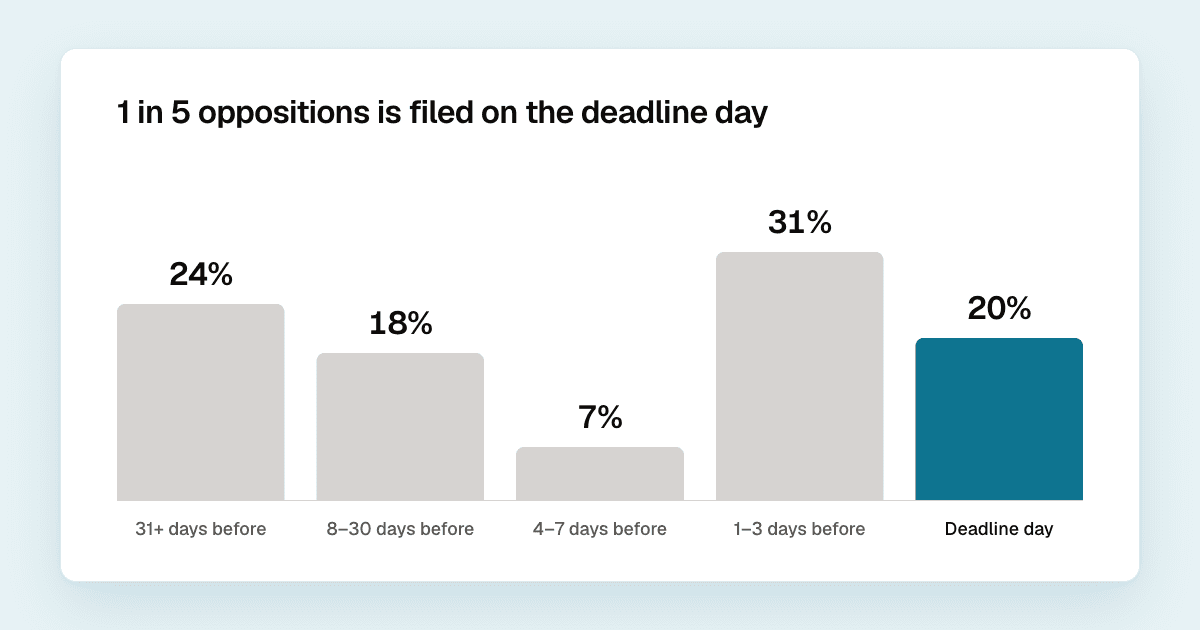
- 1 opposition in 5 is filed on the last day of the four-month window, and half within three days of the deadline.
How big is a Trade Marks Journal?
The twelve most recent journals, published between 10 August and 26 October 2026, held 75,810 marks.
| Measure | Value |
|---|---|
| Marks per journal | 6,318 on average |
| Smallest and largest journal | 4,476 and 11,128 |
| Marks "proposed to be used" | 81.8% |
| Filed through an attorney | 92.0% |
| Filed online | 96.1% |
| Device (logo) marks | 58.4% |
| Filing to advertisement | 18 months (median) |
Most marks in the journal are new brands. More than four in five claim no use yet, and are "proposed to be used". Only one in five reached the journal within a year of filing, and 7% took more than three years.
Which classes appear most in the journal
Pharmaceuticals and business services together make up more than a fifth of every journal.
| Class | What it covers | Share |
|---|---|---|
| 5 | Pharmaceuticals | 11.1% |
| 35 | Advertising and business services | 10.0% |
| 25 | Clothing and footwear | 6.0% |
| 3 | Cosmetics and cleaning products | 5.2% |
| 9 | Electronics and software | 5.0% |
| 30 | Coffee, tea, flour, spices | 4.9% |
| 41 | Education and entertainment | 4.8% |
| 42 | IT and software services | 4.1% |
Delhi handles the most applications (31.2%), followed by Mumbai (21.9%), Chennai (21.7%), Ahmedabad (16.2%) and Kolkata (5.7%). International registrations designating India make up the remaining 3.3%.
One in five had an earlier mark cited by the examiner
A mark in the journal has been accepted, but that does not mean the road was clear. In the same twelve journals, 20.9% of advertised marks had at least one earlier mark cited against them by the examiner, and 3.3 cited marks on average when they did. Their applicants overcame the objection, in writing or at a hearing, and the mark went ahead to advertisement.
The owners of those earlier marks may well want to oppose. If you act for one of them, the journal is where you will see it, and the four-month clock starts on the day it is published.
How many trademarks are opposed in India?
To see what happens after advertisement, we looked at 13 journals whose opposition window has fully closed: journals published between 30 March and 22 June 2026, with 74,545 marks.
16.5% of them were opposed, 12,279 marks facing 15,158 oppositions. Almost one in five opposed marks (18%) faced more than one opposition.
Where those marks stand today:
| Status now | Share |
|---|---|
| Registered | 52.3% |
| Accepted & Advertised, awaiting registration | 31.1% |
| Opposed, still pending | 14.4% |
| Abandoned | 2.0% |
Word marks were opposed more often than logos: 19.3% against 14.5%.
Trademark opposition rates by class
The chance of being opposed depends heavily on the class. These are the classes with at least 300 marks in the 13 journals:
| Class | What it covers | Opposed |
|---|---|---|
| 5 | Pharmaceuticals | 34.0% |
| 34 | Tobacco | 32.8% |
| 3 | Cosmetics and cleaning products | 26.6% |
| 30 | Coffee, tea, flour, spices | 25.4% |
| 29 | Meat, dairy, edible oils | 21.8% |
| 45 | Legal and personal services | 3.9% |
| 40 | Treatment of materials | 4.4% |
| 39 | Transport and travel | 6.6% |
A pharmaceutical mark is more than eight times as likely to be opposed as a mark for legal or personal services. Class 5 is the largest class in the journal, and drug names tend to be short coined words that easily sound alike.
When oppositions are filed: mostly at the last minute
This was the clearest pattern in the data. Of the oppositions to those 13 journals:
| Filed | Share of oppositions |
|---|---|
| On the deadline day | 20.1% |
| Within 3 days of the deadline | 51.0% |
| Within 7 days of the deadline | 57.5% |
| Within 30 days of the deadline | 75.7% |
| In the first 30 days after the journal | 6.5% |
One opposition in five is filed on the deadline day itself. Half are filed within three days of it.
Put another way, the deadline day alone brings almost as many oppositions (20%) as the first three months of the window put together (24%).
Four months sounds like a long time, so the review waits. But a deadline-day filing leaves no room for a document that needs a client's signature, a search that turns up something unexpected, or a portal that is slow that day. Section 21(1) of the Trade Marks Act and Rule 42 of the Trade Marks Rules give four months from the date of the journal to file the notice of opposition in Form TM-O, and no more.
Opposers are many, and mostly small
The 15,158 oppositions came from 5,224 different opponents. The ten most active opponents filed only 10.1% of them. Opposition is not the business of a few large brand owners. It is thousands of ordinary businesses protecting a name they depend on, which is why every firm with a portfolio needs to read the journal.
What this means for your practice
- Expect opposition in crowded classes. In pharmaceuticals, tobacco, cosmetics and food, one advertised mark in three or four is opposed. Tell clients early.
- Do not wait for the window to close. Most oppositions are filed in the final days. Deciding early leaves time to gather evidence and get the client's instructions.
- Watch every journal. With more than 6,000 marks a week and 5,000 different opponents a quarter, conflicts come from anywhere. A journal watch that checks each journal against your clients' marks, and ranks what is worth opposing first, turns this from a weekly chore into a short review.
Frequently asked questions
What is the deadline to oppose a trademark in India? Four months from the date of the Trade Marks Journal in which the mark was advertised, under Section 21(1) of the Trade Marks Act and Rule 42 of the Trade Marks Rules. The notice of opposition is filed in Form TM-O.
How many trademarks are opposed in India? In the 13 journals we studied whose window has closed, 16.5% of advertised marks were opposed: 12,279 of 74,545.
Which trademark classes are opposed most? Pharmaceuticals (class 5, 34%), tobacco (class 34, 33%), cosmetics and cleaning products (class 3, 27%) and staple foods such as coffee, tea and spices (class 30, 25%).
How long does it take for a trademark to reach the journal? The median time from filing to advertisement was 18 months in the journals we studied. One mark in five reached the journal within a year.
How we counted
The data comes from the Trade Marks Journals and the public register, as recorded in TM Manager on 28 October 2026. "A journal at a glance", the class shares, the office shares and the cited marks use the twelve journals 2273 to 2284 (10 August to 26 October 2026). Oppositions and current status use the thirteen journals 2254 to 2266 (30 March to 22 June 2026), whose four-month window has closed. An opposition's timing is its filing date against the journal date plus four months; 73 oppositions dated after the deadline were left out of the timing figures. Class shares use each mark's main class. Figures are rounded to one decimal place.
Want to see your clients' marks against every new journal? The journal watch is part of TM Manager. If you are not on TM Manager yet, contact us.